Desmos for the SAT · Technique 15 of 15
Solve Trig Equations in Degree Mode
Flip Desmos to degrees, graph the trig equation, and click the crossing.
Trig on the SAT is in degrees, but Desmos assumes radians until you tell it otherwise. That one setting is where almost every trig mistake comes from: type sin(30) in the default mode and you get -0.988, not 0.5.
So the whole move is: switch to Degree mode first, then treat a trig equation like any other. Put each side on its own line, and click where the graphs cross to read the angle.
Click the wrench icon (Graph Settings) in the top right and choose Degrees. Do that the instant you see a sine, cosine, or tangent, and the rest is just reading the graph.


Nova
Trig looks intimidating until you realize the SAT hides one trap in almost every trig question: radian mode. Flip Desmos to degrees, and a scary-looking equation turns into clicking a crossing like any other.
The algebra way vs the Desmos way
This technique sidesteps recalling exact values off the unit circle.
The algebra way
- Remember that
sin(30 degrees) = 0.5from the unit circle or a special triangle. - Keep 30, 45, and 60 straight, and track which are for sine versus cosine.
- Mix up the reference angle or the mode and the answer is wrong.
The Desmos way
- Switch to Degree mode, then type
y = sin(x)andy = 0.5. - Click the first crossing and read
x = 30.
The payoff: You read the angle straight off the graph in degrees, instead of leaning on memorized unit-circle values and hoping you picked the right one.
See the move, live
That same example, already loaded in the real calculator, the one built into Bluebook on test day. Try the move yourself.
Quick reference
Common values in Degree mode
| Angle | sin | cos |
|---|---|---|
| 0 | 0 | 1 |
| 30 | 0.5 | 0.866 |
| 45 | 0.707 | 0.707 |
| 60 | 0.866 | 0.5 |
| 90 | 1 | 0 |
Before you start: set up Desmos
Switch to Degree mode for trig
Desmos defaults to radians. For any trig question, click the wrench icon and choose Degrees, or every sine, cosine, and tangent value comes out wrong.
Widen the axis bounds when the graph looks empty
Desmos opens on a small window from -10 to 10 on both axes. If a crossing, vertex, or data point sits outside that box, the graph can look empty even when an answer exists. Open the wrench icon and widen the x and y bounds until the point you need comes into view.
Step by step

Nova
Follow along one step at a time, hit Next as you go. I'll flag the spots where people slip.

Switch to Degree mode first (click the wrench icon in the top right and choose Degrees), then enter y = sin(x). This one setting is the whole game for trig.
Nova: Do the degree switch before anything else. In radians every angle value comes out wrong and the crossing lands in the wrong place.
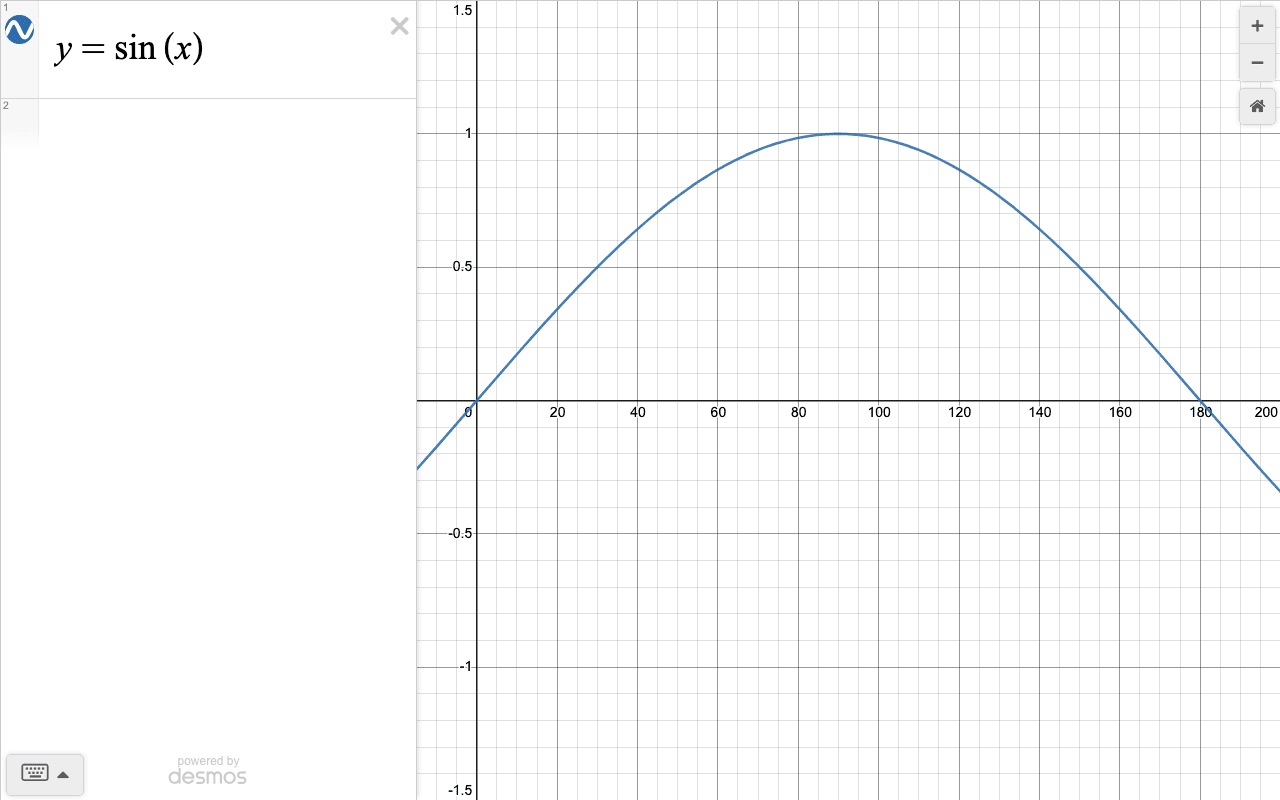
Syntax: Type sin, cos, or tan and Desmos formats it as a function. Then click the wrench icon and choose Degrees, because Desmos assumes radians and every trig value will be wrong otherwise.
Now try it on a real SAT question
The equation 2·cos(x) = 1 is given, where x is measured in degrees.
What is the smallest positive value of x, in degrees, that satisfies the equation?
Pick an answer to get instant coaching from Nova.

Switch to Degrees, graph both sides, click the first crossing. The one setting saves you from the most common trig mistake on the whole test.
In Degree mode, graph y = 2cos(x) and y = 1 and click the first crossing, or solve cos(x) = 0.5 to get x = 60. The smallest positive solution is 60 degrees.
In the app, drills like this adapt to your level, and your AI coach can walk you through any step you get stuck on.

Nova
Switch to Degrees, graph both sides, click the first crossing. The one setting saves you from the most common trig mistake on the whole test.
Set it up yourself in the blank calculator, then read the answer straight off the graph. Muscle memory beats watching.
The Desmos trap: when to close the calculator
- If the angle is one you know cold (0, 30, 45, 60, or 90 degrees), just recall the value. Graphing it is overkill.
- Set Degree mode first, every time. The SAT uses degrees unless a problem explicitly says radians.
- For a right-triangle SOHCAHTOA problem, Desmos will not draw the triangle for you. Set up the sine, cosine, or tangent ratio yourself, then let Desmos do the arithmetic.

Nova
Honest take: half of trig misses on the SAT are just radian mode. Switch to degrees the second you see sin, cos, or tan, and you have already dodged the most common trap.
Put this move into real practice
"Solve Trig Equations in Degree Mode" shows up all over the real SAT. SAT Prep Quest drills the skill at your level, so reaching for it becomes automatic by test day.
Practice freeSAT is a registered trademark of the College Board, which was not involved in producing, and does not endorse, this product. Score estimates are Learner Labs projections, not official College Board scores.